TRANSPORT UPDATE / PENANG
Penang Mutiara Line: when does a home become genuinely rail-connected?
A future station can improve a real journey, but only when the route, timing and household destinations line up. Use the announced line as a reason to test the whole trip—not as a shortcut to assume every nearby project will benefit equally.
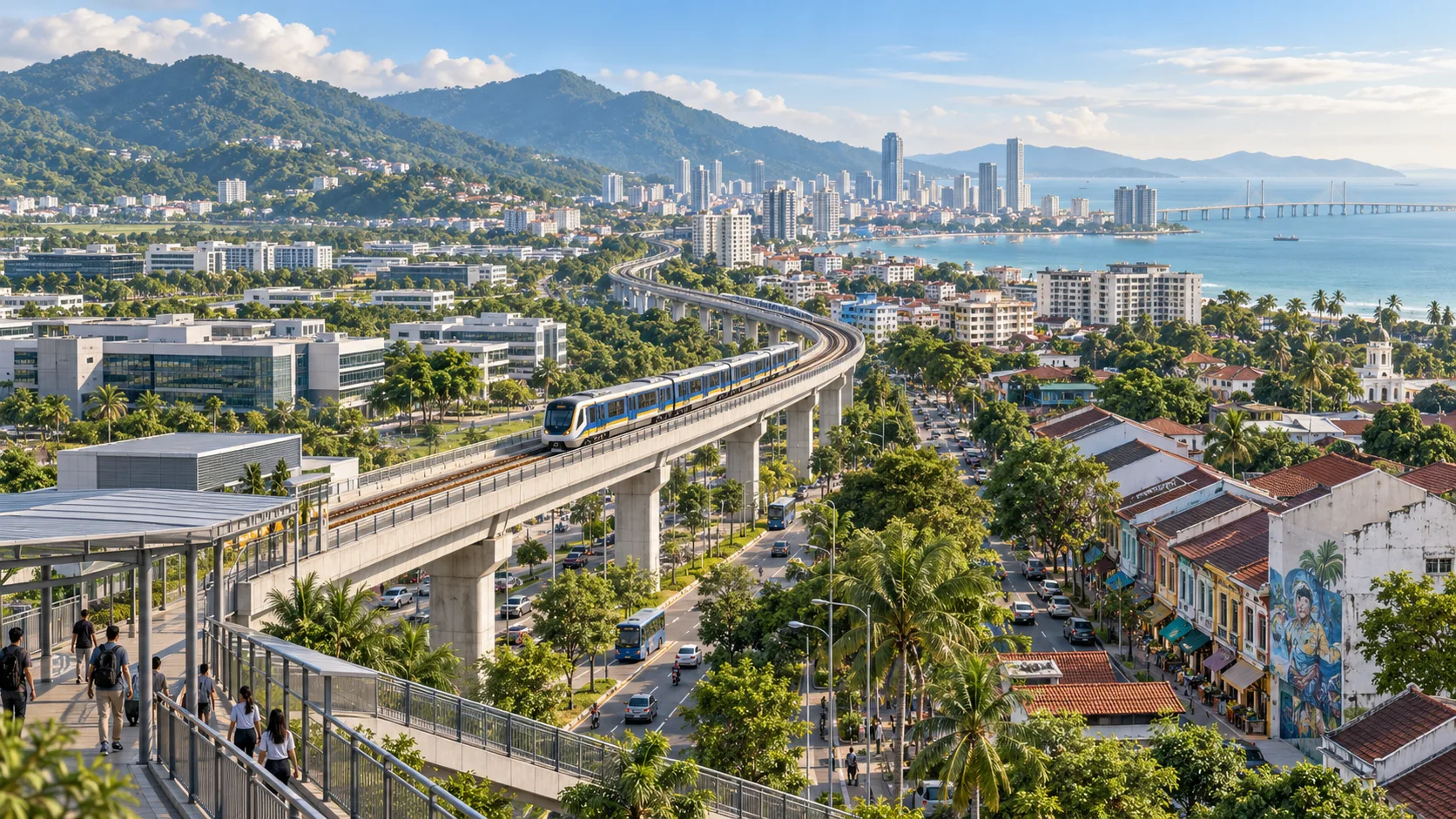
The alignment is useful only after you place your own week on it.
The official project describes a line of approximately 29.67 km linking the Penang International Airport and Bayan Lepas industrial area with George Town and onward connectivity toward Penang Sentral. That creates a potentially valuable north–south spine, but a long alignment contains many different residential markets and first-mile conditions.
Mark the three destinations your household uses most: workplace, school or university, family, healthcare and the regular intercity connection. A station near home is only one end of the journey. The destination station, transfer, operating hours and final walk decide whether rail can replace a car trip often enough to matter.
Bayan Lepas, Gelugor and George Town solve different journeys.
Bayan Lepas deserves attention from households whose week is anchored by the airport, industrial area or southern-island employment. Gelugor and The Light can form a middle position for routes that split between the south and George Town. A George Town address starts from a different priority: access to the established city and its daily services.
Do not rank these areas by station distance alone. Compare the home-to-platform route, then continue to the household’s actual destination. A project farther from one station can still be the better choice when work, schools, family and weekend life cluster around it.
| Starting area | Possible strength | Question to test |
|---|---|---|
| Bayan Lepas | Airport, industrial and southern-island routines | Can rail replace the household’s busiest work journey? |
| Gelugor & The Light | A middle-island position with links north and south | How will the exact residence reach the future station safely and comfortably? |
| George Town | Established city destinations and daily services | Will the line serve the places used weekly, or only occasional trips? |
“Near the line” is not the same as an easy station journey.
Measure from the residential entrance, not the centre of the development or a map pin. Include crossings, gradients, shade, drainage, construction barriers and the route after dark. For an integrated or waterfront project, confirm whether the connection is direct, public, sheltered and available at the hours residents need it.
Test the alternative for heavy rain, groceries, children and older family members. Some households will still need a feeder, ride-hailing or park-and-ride step. That does not make the rail irrelevant, but it changes how much convenience—and price premium—the location deserves.
Separate the home’s completion date from the line’s delivery programme.
A project may complete before the full transport benefit is available, or a completed home may pass through several years of nearby construction. Treat the residence and the rail programme as two timelines. Your financing, rent, move-in plan and road access continue during the gap.
Ask whether the home still works if the transport programme changes or takes longer than hoped. The layout, price, neighbourhood and existing routes should be acceptable without depending on one future date. When the line opens, it should improve an already workable purchase rather than rescue it.
Construction affects the present-day route before it improves the future one.
MRT Corp is publishing traffic notices for roads around the corridor, including Jalan Tengah, Jalan Sultan Azlan Shah and the Tun Dr Lim Chong Eu Expressway. Those notices show that the project already has practical consequences for some existing journeys.
Before choosing a home, drive the route during your normal peak and inspect the immediate frontage. Ask how construction access, lane changes, noise and future station works relate to the selected tower or neighbourhood. Temporary disruption should be understood separately from the long-term transport case.
Compare one completed home with two future choices.
A completed project such as Muze PICC lets a buyer inspect the access, building operation and surrounding Bayan Lepas routine. Future choices around Gelugor, The Light or Bukit Gambier place more weight on plans, completion timing and the expected route to the announced alignment.
Use the same household brief for all three: reachable plan, total purchase budget, parking, recurring costs and the exact journeys the future line may replace. This prevents a transport story from outweighing a poor layout or an inconvenient first mile.
Pay for repeated usefulness, not a station label.
A genuinely rail-connected home should reduce friction several times a week. If the line serves only occasional airport or city trips, value it accordingly. If it connects the main workplace, education and city journeys for more than one household member, it can carry greater weight.
Recheck the official alignment and construction information before committing because station plans and delivery programmes can evolve. Then decide with the home still in view: a usable plan, sensible total cost and workable neighbourhood remain necessary even beside an excellent station.